When growing eggplant, farmers often notice how leaves behave differently under chemical and organic fertilizer systems. One clear visual sign is leaf curling—some eggplant leaves curl upward, while others bend downward. What causes this? Let’s break it down by exploring five key plant science concepts:
🍃 1. Leaf Curling Behavior
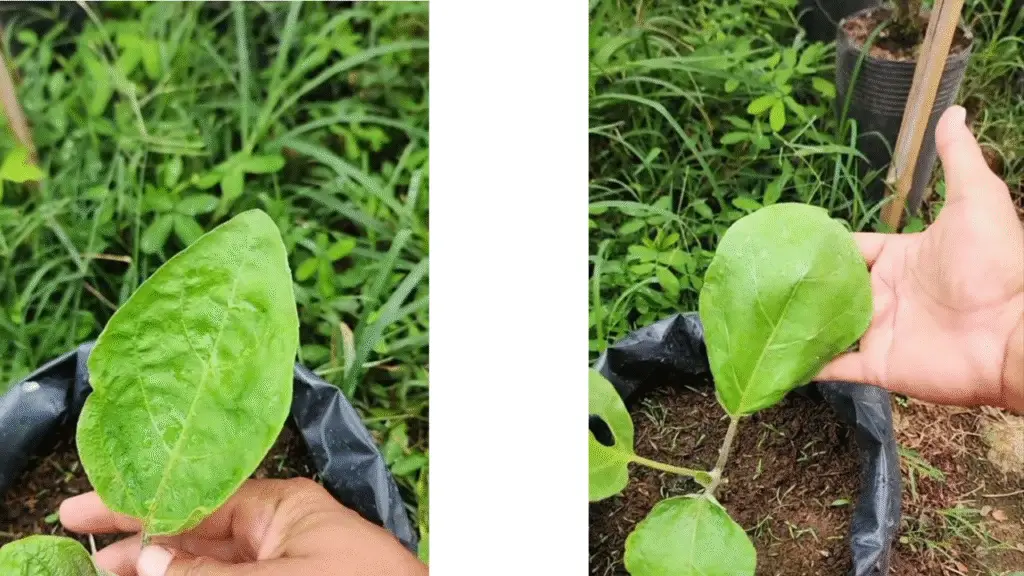
Leaf curling in eggplant can be a visible indicator of plant health. When leaves grow large and droop with their edges turning downward, it often means the plant is growing rapidly—but possibly too fast. On the other hand, leaves that curl slightly upward often indicate a slower, more balanced growth with stronger structure.
Downward curl = soft, rapid growth
Upward curl = firm, healthy balance
This behavior is closely tied to how your fertilizer works.
⚡ 2. Nutrient Uptake Speed
Chemical fertilizers like 16-16-16 release nutrients very quickly. Plants absorb these immediately, leading to fast and vigorous growth, especially in leaves. This fast uptake can sometimes overwhelm the plant, leading to overly soft tissue and heavy leaves that droop.
Organic fertilizers like 3-2-2, however, release nutrients slowly. This steady uptake supports strong, gradual growth—which means leaves stay firm and well-formed without excessive weight.
🧪 3. Chemical vs Organic Fertilizer
| Feature | Chemical 16-16-16 | Organic 3-2-2 |
|---|
| Release Speed | Fast | Slow |
| Leaf Size | Larger | Moderate |
| Leaf Edge Curl | Downward | Upward |
| Growth Rate | Rapid | Balanced |
| Long-term Soil Health | Weakens | Improves |
Chemical fertilizers are effective short-term but can cause imbalances. Organic fertilizers not only improve soil health over time, but they also support the natural development of your plants’ leaves and structure.
💧 4. Turgor Pressure in Plants
Turgor pressure is the internal water pressure within plant cells that keeps leaves standing firm. When nutrient levels are balanced, and cell walls are strong, leaves hold their shape well.
Chemical-fed plants grow fast, drawing lots of water into their cells quickly. But if potassium or calcium is lacking, turgor pressure may drop, and leaves begin to droop.
Organic-fed plants build stronger cell walls over time, helping leaves stay upright and even curl slightly upward as a sign of healthy pressure.
🌱 5. Eggplant Leaf Structure
Under chemical fertilizer, eggplant leaves tend to be:
With organic feeding, leaves are:
Slightly smaller but firmer
Dull or matte, with more texture
Edges curling slightly upward due to strong tissue and better nutrient balance
This physical difference is important for farmers to recognize. It helps in adjusting fertilizer practices to match the desired plant growth behavior and long-term health.
✅ Conclusion
Your eggplant’s leaves can tell you a lot. By observing whether the leaf edges curl upward or downward, you can gain insights into your fertilizer type, nutrient balance, and plant stress. While chemical fertilizers boost fast growth, they often lead to weak leaf structure. Organic methods, although slower, tend to produce more balanced, sturdy leaves that resist stress better.
Start observing your plants closely—they’re speaking to you through their leaves!